24 Hour Comics: Bunnirah

15 05 2013

I’ve been remiss in writing about my 24 hour comic experiences on this blog. Here’s what’s happened since 2009′s Shamanic Lemonade:

wp4HI missed two 24HC events in 2010. In 2011, we ended up with no family obligations for Thanksgiving, and I thought it would be fun to host a 24HC event at home that weekend. Only Adrian Wallace was able to stay the whole time, but we had fun and I produced The Four Humors. We spent a lot of time goofing off, so I had to draw a lot of essentially single panel pages to finish in time. This may be my weakest 24 hour comic, but I’m happy with it. It’s pretty much an elaborate pun I just had to get out of my system.

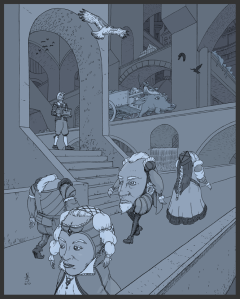
WPcrepsIn May of 2012, I hosted another gathering, on a weekend less prone to family commitments. This would be my last group 24HC event in Portland. I’m glad my good pals Adrian, Conch, and Spider were able to make it. By this time I’d posted all my 24 hour comics to my new site on Comic Fury. I figured if I do two 24 page comics a year, I could post one page a week all year long. However, I found with The Four Humors that 1 page a week is too slow. So for The Crepusculars, as an added challenge, I drew on extra large paper and designed each page to split in half, so that I could have two pages to post each week. In other words, 48 pages of narrative on 24 sheets of paper. Would this be twice as arduous as 24 straight pages? Not at all. It prevented me from using some of my tried-and-true shortcuts, and forced a denser story, but certainly was not twice the work of the comics I’d done before. I’ve stuck with this format ever since.

WPbky2The rest of 2012 was consumed by prepping the house, selling the house, and moving to Minnesota. On the official 24 Hour Comics Day in early October, we had just put the house on the market. There was no way I or anyone else could expect to plant ourselves for a whole Saturday of drawing comics. But then the house sold, much faster then we expected. Then Marcie left for her week-long conference in LA. There was still much to be done for the move,  too much to devote a whole weekend to comics (it’s best to set Sunday aside to sleep and recover), but I decided to try to work it in around the move preparations. My plan was to draw 12 pages in 12 hours for two consecutive days while I had the house to myself. What I discovered is that there is no substitute for setting aside 24 hours and sticking to that one day deadline. Things came up, there were distractions, amorphous breaks, and I couldn’t accrue 12 hours of drawing in a day. It then became just like any project that you work in around your daily life, and took me three weeks to complete. It’s not really a 24 hour comic at all, but it is The Return of Blinkey.

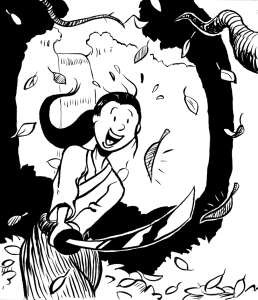
WPBunnirahBy Christmas we were in our new house in Minneapolis. In May, Marcie traveled again for a meeting and I had the place to myself for a week with no pressing engagements. On the spur of the moment I decided to draw a 24 hour comic. Months ago I had mentioned a dream I had on Facebook, in which I drew a comic about a giant radioactive vampire bunny. Several people demanded that I make the dream a reality. I knew then who would star in my next 24 hour comic: Bunnirah, Count of Monsters. This was my first completely solo, legit 24 hour effort. I never managed to hit the one page per hour pace, even thought I broke the split-page format a couple of times to speed things up. At hour 24 my last five pages were still in pencil, and the story was only 22 pages long. I didn’t want to rush inking the final pages, so I threw in the towel and went to bed. I dozed for about an hour, and then people were working on the street outside (a hazard of doing 24 hour comics midweek), and the dog was barking, and I couldn’t sleep. I read, watched tv, expected to doze off again, but didn’t. So I went upstairs and finished inking the comic. I consider this a successful 24 hour comic as per the Eastman Variation. It may not be my best effort, but I had an absolute blast with these characters. Be assured they will return.


The Unfair Critic vs Life Of Pi

10 05 2013

life_of_pi_ver2Warning: I will spoil everything

This is a hard post to write, because I find myself in endless ironic loops. I’m just going to barrel forward and try to ignore them, you can do as you like.

I read Life of Pi by Yann Martel. I only knew what everyone knows about it: boy gets stuck on a lifeboat with tiger. I like animals, and I like ocean voyages, and I was hoping those things would be dealt with somewhat realistically. I was engaged by part 1, about Pi’s life in India. I thoroughly enjoyed part 2, the part about being stuck on a lifeboat with a tiger. I found myself frustrated and angry by the end of part 3, when the author brings everything back around to a question of faith. It’s not the book I want it to be, which is my problem, not the author’s. The author, as far as I can tell, achieved exactly what he intended, and I commend him for it.

I didn’t see the movie, and I don’t plan to. I think I would hate it. The still images I’ve seen from the movie glisten with that CGI sheen. I don’t want this story to shimmer with magic. The situation is fantastic enough; I want the sights and sounds and smells to land with matter-of-fact, undeniable reality. I want to believe it. I want to be on that lifeboat with that tiger. I want to breathe the air in the middle of the ocean with a wild predator, at once dangerous, inaccessible, and part of a bond with a human being.

Part 2 of the book accomplishes all this admirably. Pi’s strategies for dealing with the tiger are surprising, ingenious, and plausible. Their journey is arduous and enthralling, and believable. The distance between human and tiger is never entirely bridged, because hello, it’s a wild animal. Believability is key. I desperately didn’t want the story to become fantasy. I enjoy fantasy, but with this story I was hoping to feel a more authentic connection to the natural world; the ocean, the sky, wild animals. Again, my problem. What’s the point in approaching any work of art with such specific expectations? I’m not writing the book. I can interpret it in my own way, but I don’t get to decide what happens.

Still. Expectations met, as I said, in Part 2. Even though there were some elements that stretched plausibility, that might be called magical realism. The oil tanker that blindly brushes past the castaways seems unlikely in the vast ocean, but also seems like one of those events so ridiculous it has to be true. The island of algae may or not have any basis in actual botany, but I had no trouble believing it. The one thing that really threw me was meeting the other blind sailor in the other lifeboat. That was so utterly unlikely, I thought the whole episode was a hallucination, right up until the two Japanese reps discuss it in Part 3.

Part 3, when Pi tells his story to the men from the shipping company, and they don’t believe him. So he tells them another story, with no wild animals, that they can believe. And then I start to doubt this wonderful story I’ve just finished. Why would the author do that? Probably for the same reason he wrote 100+ pages of Pi being in India and absorbing different religions. Pi is pious (is that why Martel chose that odd name for his protagonist?) and he prays a lot at sea, but it’s his empirical knowledge of zookeeping that saves him. So what’s all this religion in aid of? Only the central theme of the book, it turns out. In the end, we are given a choice. Believe the unbelievable, the much better story, or fall back on what fits with our own experience. Have faith, or don’t.

To clarify, I don’t really doubt the story with the tiger. It’s pretty clear what really happened to Pi (if anything can be said to have “really happened” in a work of fiction.) I think Martel is just giving us an exercise in faith, a miniature model of faith. I am not religious, so when I hear people talk about faith a part of me switches off. Faith is nothing to do with me. So I was frustrated to get to the end of the book and feel evangelized to, even in a most subtle and friendly way.

Still, I have to admit, all the things I wanted from this book–the sense of connection to the ocean, the sky, wild animals, the natural world–most people would call that a spiritual impulse. I don’t mind calling it that. One can seek and feel a connection to the larger universe without believing in God. We skeptics get a lot of spiritual juice from scientific observation. That’s why I so craved, and so appreciated, the realism in this story. Realism was my best path to a spiritual experience. When faith became the clear central theme, I almost felt my realist path to spiritual connection devalued.

Almost, but not quite. In the end I have to just let it go, as Pi lets Richard Parker go, connected and disconnected at the same time. Which again is the nature of spiritual experience, because unless you are fully enlightened and enter Nirvanna there will always be an element of disconnect. See! Despite my best efforts, Life of Pi remains the book its author intended. I’m gonna go read Spider-Man now.


Letter to the Editor, Special Edition

9 05 2013

My letter to the Star Tribune in response to this commentary:

Michael Ebnet’s argument against same sex marriage is flawed. Certainly there is value in a child absorbing the unique influences of both a mother and father. But more than that, a child needs unconditional love, support, and stability. A strong family provides these essential elements, whatever form it takes. What about single parents? We don’t demand that they run out and find a spouse in order to keep their children. We recognize as a society that a single parent’s situation is not everyone’s ideal, but that parent still has the right to be a parent. By the same token, it is simply unfair to deny some people the right to a family because they are not wired to marry the opposite sex.

My wife and I are a heterosexual couple seeking an open adoption. In this process we have gotten to know several gay couples, some who have adopted and some who are still waiting. They are all thoroughly kind and loving people; they are or will be excellent parents. It would be cruel and absurd to deny them the life-enriching experience of raising children. It is equally absurd to deny them the right to marry.

And here’s the snarky part I didn’t include, even though I really wanted to, but I felt it would just muddy the waters:

Ebnet goes on to raise the specter of marriages involving three or more people. But if we follow his argument to its logical conclusion, it is emphatically in favor of poly-amorous marriage. If one mother and one father is good for a child, how much better would be a mother and two fathers? Two fathers and three mothers? Imagine the wealth of “special somethings” brought by a large, diverse group of parents. Imagine the abundant energy and attention a whole team of parents could bring to a family. If Ebnet is honestly concerned about children getting a rich mix of parents, and not simply objecting to non-traditional marriage, he should be advocating for families in which the parents outnumber the children.


Iron Man 3

6 05 2013

For once I saw a movie opening night. Now it’s already 3 days later and I’ve blown my chance to write a timely movie post. Oh well. I liked the movie a lot, but I didn’t have a lot to say about it. Then I read this article by Linda Holmes. Genius. This is why, as my blog title says, I take this stuff so seriously. Because when it’s done well, it actually speaks to serious, real life situations, and offers new ways of understanding old problems.

Here’s an excerpt:

But the biggest conversation we’re having now? About balancing self-sacrifice and ego and capitalism, generosity and gadgetry, embracing other human beings versus shutting ourselves inside ever more advanced fortresses at every level from national security down to personal technology? It’s pure Tony Stark.

click for full article


My Favorite Part of Django Unchained (Spoilers!)

26 02 2013

The pre-Civil War South is a land of insanity. The most loathesome, dehumanizing acts are protected by the law, and people of good conscience must move with utmost care. To stand up for simple decency could cost one everything.

Django’s wife Brunhilda is owned by Mr. Candie. Django and Schultz go to the plantation to buy her. They have to trick Candie into believing that they are as monstrous as Candie, as the whole society of a slaver nation. Candie must believe that they see Brunhilda as a commodity, not a person.

While Candie is entertaining them, a woman plays Beethoven on a harp. Schultz can’t stand it. The atrocities he’s witnessed play back in his mind, and he demands that the harpist stop. He can’t abide the beautiful culture of his native, eminently civilized Germany in the heart of the evil empire.

It’s a stunning reversal of every tale of American heroism in Nazi Germany– especially the one featuring Christoph Waltz as the Nazi, also by Tarantino.

It’s a subtle scene, and it happens fairly quickly, but it shook me much more than any of the amped-up spaghetti-western bloodshed. Somehow Tarantino’s signature goofiness serves to emphasize the deadly serious history lesson. The righteous happy ending of Django Unchained could only happen in a cartoonishly unreal Old South. Attitudes of American exceptionalism can only be maintained with a cartoonishly unreal grasp of history.


The Dark Knight Rises Revisited

21 01 2013

Yes, it’s another not-at-all-timely movie post. The other night I watched The Dark Knight Rises for the second time, the first time I saw it since it opened in theaters. I really wanted to like it then, enough that I enjoyed watching it once. But its flaws were too much for a second viewing. I probably could have overlooked them all, if I wasn’t immediately tripped up by how wrong they got Batman.

Batman is supposed to be relentless. He is someone who draws strength from the tragedies of his past. He is committed to his personal crime-fighting mission beyond ordinary rationality. Yet, the movie begins by telling us he gave it all up — due to a broken heart – and has been idle for 8 years. Which incidentally means that the sum total of Batman’s career is the first two movies. If he only ever fought The Joker and Ras-al Ghul, he’s not much of a superhero.

Superheroes are not complicated characters. That’s a large part of their appeal. The name and the costume should give you all the vital information you need as an audience. Not all there is to know, but all you need to get on board. (This is why the show Heroes never worked– they eliminated hero names and costumes. That and the stupid stories.) Uncomplicated does not mean unsophisticated; superheroes can have rich inner lives, inhabit complex worlds, experience convoluted plots.  But, dear moviemakers, you have to stay true to the characters’ root elements. Do that, and you can have a whole thrilling ensemble of distinctive mythic beings, like The Avengers. Fail to do it, and you get Green Lantern, Spider-man 3, Daredevil, etc etc.

As a standalone action movie, The Dark Knight Rises isn’t bad. But The Dark Knight really raised the bar. It captured Batman and The Joker so well, it illuminated the whole superhero/supervillain dichotomy. To wit: a superhero turns weakness into strength. Within himself at minimum, within others when at his/her best. A Supervillain turns the strength of others into weakness. Watch it again and see how beautifully that basic conflict plays out. That’s what I’ll be doing. What third movie?


Moving: The Drive

31 12 2012
We're not skiers, but our car came with protective snow charms.

We’re not skiers, but our car came with protective snow charms.

Day 1 – Out Of Portland

We’d heard from various people that we were varying degrees of nuts for driving from Portland to Minneapolis in the middle of December. We didn’t have much choice; the timing was determined by the sale of our house, which happened much faster than we expected. Still, we thought we’d have at least until Idaho to worry about the weather, but it snowed in Portland the morning of our departure. We loaded the last of our stuff, said our last goodbyes to the neighbors, and drove through rush hour in a town that gets totally paralyzed by an inch of snow.

Once we got out of the Willamette valley, the weather cleared up completely. We had an easy drive from Hood River to Pocatello, Idaho, our first night’s stop. The animals both adapted to the car really well. Teagan usually rides with her front feet on the center console or the passenger’s left leg. To tempt her into the back seat, we built up a thick nest of blankets and pillows. She was willing to settle in back there if one of us rode in the back seat with her. Fizzgig’s carrier was on top of some other stuff in the very back, with the door propped open and a cat bed inside. After he had explored the whole car, he decided the carrier was the place to be and spent almost the entire ride up there.

Since we can’t stay in motels with the dog, we had booked a cabin at the Pocatello KOA. We tried to reserve KOA cabins for all three nights, but had trouble finding ones that were open in December. Tuesday night, we understood why. It was 17 degrees outside, and 17 degrees inside the cabin. There was a small electric space heater, but it didn’t appear to have any effect. We brought all the blankets in from the car and got under them with the animals. We wore our hats and gloves. Marcie wore her new coat, purchased for the sub-zero Minnesota winter. It seemed impossible that we would ever warm up, but we did. Teagan eventually crawled out and slept on top of the covers. No one froze. We did get some funny looks from the staff in the morning when we checked out.

Day 2 – Crossing the Rockies

This was the part of the trip we were most worried about. We chose to drive east on I80, thinking we’d do better than the more northerly I90 and not wanting to go as far south as I70. Even though I grew up in Denver, my knowledge of Rocky Mountain geography is vague. A cursory search of online topographical maps made I80 look the most promising as far as easy mountain passes. This may be because, as I learned from our road map on the way, I80 crosses the continental divide at a location where it flattens out into a wide basin. In any case, this was another easy day. We had beautiful weather again and no problems at all with the roads. We came down from the mountains out of Laramie, Wyoming, on a winding stretch of freeway that was a bit more treacherous, but only lasted for 20 miles or so. By the time we hit Cheyenne it was smooth sailing again.

From there we turned south to Denver, to stay with my parents for the night. It was a bit out of our way, but we got to visit my folks and my brother, and there were no open cabins in the Mountain time zone. It was great, except for Teagan fighting with their dog.

Day 3 – After the Blizzard

We left early Thursday morning, knowing we had a long day ahead of us. We had to be in Minneapolis by noon on Friday, so our next stop would be a lakeside cabin in Fairmount, Minnesota. From there we’d have an easy 2 and a half hour drive to Minneapolis.

From Denver, we headed northeast on 76, which meets I80 at the border of Nebraska. On the way, we saw signs saying I80 was closed. The weather was so clear we had trouble believing it. But sure enough, shortly after getting on 80 we were diverted to a truck stop in Big Springs. The day before, a massive blizzard had rolled over Nebraska, and they were still clearing wrecked trucks off the interstate.

The truck stop parking lot was packed with cars and trucks. The multi-purpose building had people sitting at every table and milling about everywhere. No one had any real information about what was going on. A woman at a tourism desk said the road was supposed to open by noon, which would mean a half hour wait. We had lunch and then sat in the car with the animals. Shortly after noon, it looked like things were moving, so we decided to get out of the parking lot before the mass truck exodus. However the freeway was still closed, so we got diverted to the ramp on the opposite side, and parked in the line of cars along the edge, pointing at the on ramp. It was a much better position to be in when traffic started moving, but there was nothing to do but wait in the car. We turned on our audiobook of Abraham Lincoln: Vampire Hunter. We looked for alternate routes on the map, but all of them would add 3 to 5 hours, if the roads were clear, which we had no way of knowing. Luckily the animals were calm. In town, if we drive around with Teagan, she gets antsy and whines if we stop and sit around in the car. This time she curled up on her pile of blankets and went to sleep. Fizzgig stayed happily ensconced in his carrier. After a two and a half hour wait, the road finally opened.

For the first twenty miles or so, it was perfectly dry and smooth. But, gradually, we encountered more and more chunks of packed ice and snow. It was a little slippery and very bumpy. We had to slow down to 40 mph or less, all the way across Nebraska. We passed several wrecked trucks in the median, one that looked like the trailer had been wrung out like a towel by giant hands.

It was a long, slow, nerve-wracking drive to Omaha, which we reached after dark, but we could only thank our lucky stars that the bad weather had stayed ahead of us the whole trip. We were very glad for the Subaru, for all-wheel drive, for snow tires, and for anti-freezing window cleaner. Though it wasn’t snowing, passing vehicles threw up a shower of sticky, frosty grit. We stopped for gas, and I scrubbed the grime off the windows, with a gas station squeegee also resting in antifreeze cleanser. We’d heard more bad weather predictions for Iowa, so we turned north on I29, and would continue east on 90. Heading up 29 I thought the headlights were giving out, or the air was foggy, or fatigue was making me blind, until I realized I should have scrubbed the headlights as well as the windows. We gassed up in Sioux Falls, at a station that had their squeegees resting in a bed of crystalized, frozen cleanser. But it worked okay on the headlights. We reached Fairmount at 4 am, unpacked our bedding and the animals stuff, and slept for 3 hours.

Day 4 – Into Minneapolis

We’d been lucky, there was no denying it, but we’d also benefited from our own good decisions. Still, we didn’t want to congratulate ourselves too early. It was hard not to. We woke up on Friday to more clear blue skies, more clear dry roads. We learned that if we had stayed on 80 to Des Moines, we’d be stuck at the wrong end of 35, now closed all the way to Minnesota. But it was open north of 90, which was what we needed. We cruised up into the Twin Cities, and arrived at our new house twenty minutes before our appointment for the final walk through. The car looked like it had been through some hellish parallel dimension, covered in competing filigrees of frost and dirt. I sort of wanted to leave it that way, but we ended up washing it a couple days later.

It’s now just over a week later. Marcie is back to work in an office for the first time in a month. We’re still unpacking. It appears that all of our stuff made it here, the vast majority of it intact. It’s a brilliant sunny day, hovering between 10 and 20 degrees, like most days since we got here. Fizzgig is right at home, prowling the house at night and lazing around all day. Teagan is still a little anxious, but adjusting to the cold. When she makes some doggie friends, all will be well.

Friday night we met many of our neighbors at a holiday block party. There are three families on our street with adopted children. Hopefully this year we will become the fourth.


Follow

Get every new post delivered to your Inbox.

Join 343 other followers